SILVERSTONE 2026 PADDOCK FITS THAT DESERVE A PODIUM

Updated: Jul 27

Why Casual Elevated Fashion Became Formula 1’s New Luxury
There was a time when Formula 1 fashion could almost be reduced to a single question: how much did it cost?
As the sport expanded beyond the circuit, so too did interest in the people occupying the paddock. Grand Prix weekends became cultural events where celebrity, fashion and motorsport increasingly collided, but the conversation surrounding style often became focused on recognition rather than interpretation. Coverage frequently revolved around identifying five-figure handbags, limited-edition watches and luxury labels worn by drivers' partners, influencers and high-profile guests, reducing personal style to little more than a running total of price tags.
Silverstone 2026 felt refreshingly different.
The outfits that remained memorable long after the chequered flag had fallen were not necessarily the most expensive. They were the ones that understood the environment they existed within. They reflected the unpredictable British weather, the miles walked between hospitality suites and grandstands, and the unique atmosphere of a race weekend that is as much about experiencing the sport as it is observing it. They were polished without appearing overworked, practical without becoming ordinary and fashion-forward without feeling disconnected from the reason everyone was there in the first place.
The defining trend of the weekend was clear: the rise of casual, elevated dressing.
This does not mean luxury has disappeared from Formula 1. The paddock will always have a relationship with prestigious fashion houses, fine jewellery and beautifully crafted accessories. However, luxury is no longer the sole foundation of a successful outfit. Instead, it has become one element within a much broader approach to dressing—one where thoughtful styling, strong silhouettes, individuality and personality matter just as much as the label inside the garment.
That shift feels particularly significant because fashion should never become a competition over who can spend the most money. At its best, style is not an expression of purchasing power; it is an expression of identity.
The strongest looks at Silverstone demonstrated exactly that. A perfectly cut pair of jeans, a beautifully tailored jacket, an unexpected accessory or an intelligent combination of textures could create just as much impact as a head-to-toe designer ensemble. The difference was that these outfits succeeded because of how they were styled, not because of what they cost.

In many ways, that evolution mirrors Formula 1 itself.
Over the past decade, the sport has transformed into a global cultural phenomenon that extends far beyond racing. Social media, Drive to Survive and Formula 1's expanding international audience have turned Grand Prix weekends into spaces where motorsport, fashion, music and entertainment naturally intersect. The paddock is no longer simply a working environment for teams and drivers; it has become a stage for personal expression.
With that visibility comes an opportunity to redefine what Formula 1 fashion represents.
For too long, paddock style has been associated with aspiration in its most exclusive form. While there is undeniable artistry in luxury fashion, reducing an outfit to its price tag overlooks the element that makes style genuinely compelling. A designer handbag may be beautifully made, and an investment piece may hold incredible craftsmanship, but neither can replace creativity. A label can enhance an outfit, but it cannot create personality. The most memorable fashion has never been defined by what something costs—it has always been defined by the story it tells.
Silverstone 2026 represented a shift towards a more democratic vision of paddock style.
The best outfits looked intentional rather than intimidating. They reflected the reality of attending a Formula 1 race: long days outdoors, unpredictable conditions, constant movement around a huge circuit and a desire to participate in the atmosphere rather than simply pose for photographs. Practicality was no longer viewed as a compromise. Instead, it became part of the aesthetic.
Perhaps that is why Silverstone has developed such a distinctive fashion identity.
Unlike Monaco, where Mediterranean glamour, old-world luxury and a more formal atmosphere naturally influence the dress code, the British Grand Prix demands something different. Silverstone has always been more grounded. The weather is famously unpredictable, the circuit requires endless walking and the energy of the weekend is built around movement. The ideal outfit needs to feel sophisticated enough for the paddock while remaining comfortable enough to experience the race itself.
That balance has become the foundation of modern Formula 1 fashion.
Today's strongest paddock wardrobes are built around contrast: relaxed denim paired with structured tailoring, investment accessories mixed with accessible staples, timeless colour palettes elevated with unexpected details. They appear effortless, but that effortlessness is carefully constructed.
And perhaps that is the greatest misconception about effortless style...
The outfits that look the most natural are rarely accidental. They are the result of thoughtful decisions—understanding proportion, knowing when to introduce a statement piece, recognising when restraint creates more impact than excess and appreciating that confidence often comes from simplicity rather than spectacle.

This shift is part of a much wider transformation taking place across fashion.
For years, the industry was dominated by maximalism: visible logos, recognisable designer pieces and carefully constructed looks designed to communicate status. Fashion became a language of exclusivity, where being recognised sometimes mattered as much as being well dressed. However, recent years have seen a move towards clothing that feels more personal and considered. Consumers are increasingly drawn towards quality, versatility and pieces that reflect individual identity rather than simply demonstrate awareness of the latest trend.
The paddock has naturally absorbed that change.
Formula 1 has always had an intrinsic relationship with style. Racing jackets, team uniforms, sunglasses, watches and technical fabrics have long been part of motorsport culture, creating a visual language associated with speed, precision and performance. Yet the most compelling modern interpretations of racing-inspired fashion are not the ones that recreate the sport literally. Instead, they borrow subtle elements from its heritage: the structure of a leather jacket, the sharpness of tailored outerwear, the functionality of technical materials and the confidence of a strong silhouette.
The result is fashion that acknowledges Formula 1 without becoming a costume.
There is a difference between dressing for Formula 1 and dressing as though you are attending a Formula 1-themed event. The strongest paddock outfits do not rely on obvious branding or predictable racing references. They understand the history and atmosphere of motorsport while allowing personal style to remain the focus.
The future of Formula 1 fashion is not about recreating racing uniforms or simply wearing luxury labels. It is about interpretation—taking elements of motorsport, everyday fashion and individual expression, then combining them into something that feels authentic.
That was the defining quality of Silverstone's strongest looks in 2026.
They did not attempt to compete with the theatre of the cars or the excitement of the racing. Instead, they complemented the environment around them, capturing the spirit of the weekend through thoughtful styling rather than excessive display.
They did not just look fashionable...
They looked like they belonged at Silverstone.
Sophie Milner: The Power of Understated Precision

Sophie Milner’s Silverstone look represents perhaps the most difficult achievement in fashion: making simplicity feel exciting.
In an environment where attention is often captured by bold colours, recognisable logos and statement pieces designed to dominate photographs, Sophie took the opposite approach. Her outfit did not demand attention—it earned it. Built around a restrained monochrome palette of crisp whites and soft neutrals, the look demonstrates the power of considered styling and the idea that true sophistication often comes from knowing exactly what to leave out.
Minimalism is frequently misunderstood as a lack of creativity. In reality, the most successful minimalist outfits require an incredibly strong understanding of proportion, texture and balance. When there are fewer elements to hide behind, every detail becomes more important. A silhouette must be precise, fabrics must work together and accessories need to add character without disrupting the overall harmony.
Sophie’s outfit succeeds because it understands that philosophy perfectly.
The foundation of the look is the Lioness Penny Jeans, a piece that transforms a simple outfit into something much more fashion-conscious. White denim has always held an interesting position within contemporary style. It carries the effortless optimism of summer dressing, but it can also easily become too polished or overly pristine if not balanced correctly. The challenge is making it feel relaxed rather than restrictive, elevated rather than overly styled.

The Penny Jeans achieve that balance through their silhouette.
The low-rise fit and straight-leg shape create a distinctly modern proportion, referencing current fashion movements without feeling like a temporary trend. Rather than relying on a body-conscious cut, the relaxed structure allows the denim to move naturally, giving the outfit a sense of ease that feels particularly appropriate for Silverstone. It is a piece designed for someone who wants to look polished while still being able to spend an entire day moving around a circuit.
The jeans become the quiet hero of the outfit.
Their structure provides the foundation, while the statement button detailing introduces a subtle point of difference. This is where the look demonstrates the sophistication of modern minimalism: the personality does not come from excessive decoration, but from carefully considered details. Nothing feels accidental, yet nothing feels forced.
The tie-back white top continues this approach. At first glance, it appears to be a simple wardrobe staple, but the open-back detailing introduces movement, femininity and softness. It prevents the outfit from becoming too structured, creating a contrast against the sharper silhouette of the denim.
That contrast is what makes the styling feel so refined.
The jeans bring a contemporary, slightly utilitarian edge, while the top adds delicacy and fluidity. Together, they create a silhouette that feels confident without being severe, feminine without becoming overly romantic. It is a balance that many of the most influential modern fashion houses have embraced: combining strength and softness within the same look.
The Coachtopia Ergo bag completes the outfit by demonstrating the importance of accessories within contemporary paddock dressing.
Rather than functioning simply as a luxury symbol, the bag plays a genuine role in the composition of the outfit. Its shape, texture and structure introduce depth into an otherwise clean palette, creating visual interest without overwhelming the simplicity of the clothing. It enhances the outfit rather than competing with it.
The strongest accessories are not always the ones that announce themselves most loudly. They are the ones that make the entire outfit feel more complete.
That is exactly why Sophie’s look feels so aligned with the future of Formula 1 fashion.
It embraces luxury without relying on excess. It feels elevated without appearing inaccessible. Most importantly, it proves that an outfit does not need to be covered in recognisable labels to communicate confidence and sophistication.
In many ways, Sophie represents the quieter side of Silverstone style—the person who understands that confidence does not come from being the loudest person in the room. It comes from knowing your own aesthetic and trusting it completely.
In a paddock environment where so many looks compete for attention, restraint becomes its own form of statement.
Her outfit is a reminder that great fashion is not always about adding more. Sometimes, the most powerful choice is knowing exactly what to leave out.
Kezia Cook: Motorsport Heritage Reimagined

If Sophie Milner’s look represented the understated elegance of the new Silverstone aesthetic, Kezia Cook’s outfit captured the other side of the movement: confidence, individuality and the power of a true statement piece.
The beauty of modern paddock fashion is that it does not exist within one defined aesthetic. The most exciting race-weekend wardrobes are not built around a single formula; they exist somewhere between minimalism and maximalism, tradition and experimentation. Some outfits embrace quiet sophistication, while others use fashion as an opportunity to make a statement. Both approaches work because they are rooted in the same principle: dressing with intention.
Kezia’s look understands that balance perfectly.
At the centre of the outfit is the Mauritius Christy leather jacket, a piece that immediately highlights one of the strongest connections between motorsport and fashion. Few garments carry the same cultural weight as leather outerwear. Long before Formula 1 became associated with luxury hospitality, celebrity guests and global fashion partnerships, leather represented something much more functional: protection, speed and rebellion. It belonged to drivers, mechanics and riders, becoming a symbol of performance and confidence before it ever became a fashion statement.
That history gives leather jackets a natural place within the paddock.

However, the challenge with motorsport-inspired fashion has always been knowing where to draw the line. There is a fine balance between referencing the sport and dressing like you are wearing a costume. Obvious branding, excessive racing motifs and predictable styling choices can make an outfit feel more like a theme than a personal expression.
The strongest interpretations understand that inspiration does not need to be literal.
Kezia’s jacket succeeds because it takes the heritage of motorsport and translates it through a modern fashion lens. The leather silhouette brings attitude and history, while the star appliqué detailing across the back transforms the piece into something far more individual. It takes a familiar item and gives it a distinct identity.
That is the power of a statement jacket...
The best outerwear does not simply complete an outfit; it establishes its entire mood. It becomes the piece that tells the story, allowing the rest of the styling to support rather than compete. In Kezia’s case, the jacket provides the confidence and edge, while the surrounding elements create balance.
The colour palette strengthens the impression of it feeling personal rather than predictable.
The combination of red, white and blue subtly connects the outfit to the atmosphere of Silverstone, but importantly, it does so without relying on obvious references to the British Grand Prix. It feels inspired by the occasion rather than created solely for it.
That distinction is what separates thoughtful paddock fashion from event dressing.
The best outfits acknowledge their surroundings while still feeling like they belong to the person wearing them.
The layering choices further enhance this idea. The grey cropped piece worn over white introduces softness and dimension, preventing the leather jacket from becoming too dominant. Leather naturally carries visual weight, so balancing it with lighter, more relaxed elements allows the outfit to feel contemporary rather than overly structured.
This relaxed confidence is one of the defining characteristics of modern Formula 1 style.
The paddock is no longer a place where people simply dress formally because they are attending a prestigious sporting event. Instead, it has become a space where streetwear, luxury fashion, vintage influences and everyday wardrobe staples can exist together. The most successful outfits understand that fashion today is about contrast.
Kezia’s look sits directly within that intersection.
Then come the zebra-print shoes—a styling choice that introduces an element of unpredictability.
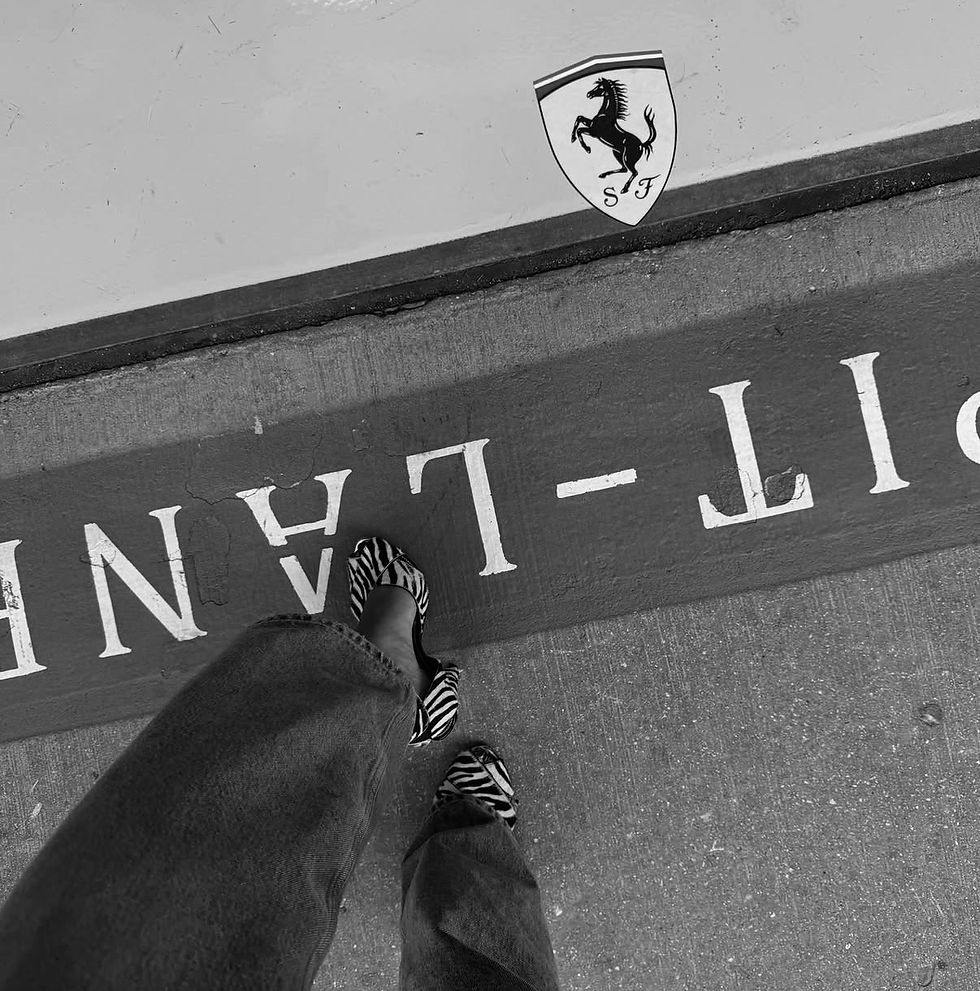
Animal print is notoriously difficult to balance. Used incorrectly, it can quickly become the dominant feature of an outfit, overwhelming everything around it. Here, however, the print works because the rest of the look provides enough structure. The leather jacket, monochrome layers and refined accessories create a strong foundation, allowing the shoes to bring personality rather than chaos.
This is where fashion becomes interesting.
The most memorable outfits often include one unexpected element—the detail that prevents the look from feeling too carefully constructed. The zebra print suggests confidence and a willingness to experiment. It communicates someone who understands fashion conventions but is not restricted by them.
The blue Chanel French Riviera flap bag continues that conversation between opposites.
At first glance, pairing a luxury accessory with a rebellious leather jacket may seem unexpected. However, that contrast is precisely what makes the styling feel modern. The traditional boundaries between high fashion and casual dressing are becoming increasingly blurred, and some of the most exciting outfits are created when those worlds collide.
A Chanel bag does not need to be reserved for a traditional luxury aesthetic.
A leather jacket does not need to be paired with predictable denim and boots.
Fashion becomes more compelling when familiar rules are challenged.
That is ultimately what makes Kezia’s outfit such a strong example of Silverstone 2026 style. It proves that casual elevated fashion does not mean every look has to be minimal or neutral. The movement is not defined by simplicity—it is defined by intention.
Whether someone chooses understated tailoring or a statement leather jacket, the goal remains the same: creating a look that feels authentic.
Kezia’s outfit has attitude, heritage and personality, while still feeling completely appropriate for the paddock environment. It understands Formula 1 without allowing the sport to completely define it.
And perhaps that is why the most exciting paddock outfits are often the ones where different worlds collide: where motorsport meets fashion, where luxury meets everyday dressing and where personal style becomes just as important as the event itself.
Coco Beautea: My Blueprint for Modern Silverstone Style

While Sophie Milner represented understated refinement and Kezia Cook demonstrated confident expression, Coco Beautea’s outfit captured the space between the two—the point where modern paddock fashion feels most natural.
It was polished without feeling formal, fashionable without appearing performative and elevated without becoming inaccessible. In many ways, Coco’s look represented the central philosophy behind Silverstone 2026: the future of Formula 1 style is not about creating distance, but about creating connection.
The modern paddock outfit is not about appearing as though you spent hours trying to look effortless. True effortless style comes from understanding the relationship between comfort, confidence and personal identity. It comes from knowing which pieces work together, how proportions interact and when to allow an outfit to breathe.
That balance is far more difficult to achieve than it appears.
Anyone can assemble an expensive wardrobe. Creating a look that feels natural requires something much more valuable: an understanding of personal style.
This is where Coco’s outfit succeeds.
Rather than relying on a single statement item, the look works because every element feels intentional. The pieces appear as though they belong together naturally, while still feeling like items that could exist beyond the context of a race weekend. Nothing feels chosen simply for the sake of a photograph. Instead, the outfit feels lived-in, authentic and personal.
That authenticity has become one of the defining qualities of modern fashion.
As social media has transformed how audiences engage with style, there has been a noticeable shift away from outfits that feel overly constructed or impossible to recreate. People are increasingly drawn towards personality rather than perfection. They want to see how fashion can be adapted into real life, not simply admired from a distance.
The paddock has naturally reflected that change.
The most compelling outfits are no longer necessarily the ones worn by people with access to unlimited wardrobes. They are the ones that communicate an individual point of view. They encourage inspiration rather than imitation.
Coco’s styling captures that perfectly.

The outfit is built around contrast: structured pieces softened by relaxed elements, timeless colours elevated through thoughtful details and familiar wardrobe staples transformed through styling choices. It demonstrates that elevated fashion is not always about adding more—it is often about understanding how existing pieces can work together in a more considered way.
That philosophy is particularly suited to Silverstone.
The British Grand Prix occupies a unique space within the Formula 1 calendar. It is not a formal gala, nor is it simply a sporting event. It is a constantly moving environment where fashion needs to adapt. An outfit must photograph well, but it also needs to withstand hours outdoors, changing weather conditions and the reality of navigating one of the world's most iconic circuits.
The strongest paddock looks understand that duality.
They allow someone to feel part of the occasion without losing their own identity.
That is perhaps why Coco’s outfit feels so relevant to the changing culture of Formula 1. It represents a more inclusive vision of paddock fashion—one where style is not measured by exclusivity, but by creativity and confidence.
A great race-weekend outfit should inspire people, not intimidate them.
It should encourage experimentation rather than suggest that participation requires a designer wardrobe. It should remind fans that personal style comes from choices, not price tags.
Coco’s look embodies that idea.
It proves that elevated fashion does not need to be complicated. It comes from understanding proportions, selecting pieces carefully and adding enough personality to make an outfit feel uniquely yours.
Ultimately, that is why the look works so well.
It does not attempt to compete with the spectacle of Formula 1...it complements it.
Why Silverstone’s Most Important Fashion Moment Was Also Its Most Accessible

The most significant fashion statement at Silverstone 2026 did not come from a traditional luxury house.
It came from Marks & Spencer.
When M&S hosted the first-ever fashion show on Silverstone’s iconic pit lane, it represented something far more meaningful than a brand activation. It reflected a changing relationship between Formula 1, fashion and accessibility—a recognition that the future of paddock style cannot be built solely around exclusivity.
The location itself carried enormous symbolism:
A runway has traditionally represented separation. It is a space built around exclusivity: carefully selected audiences, luxury collections and an environment designed to position fashion as something to admire from a distance. But placing that runway at the heart of Silverstone transformed the meaning entirely.
Fashion belongs here.
Not only inside luxury boutiques or on celebrities or on those with access to the most expensive wardrobes.
Fashion belongs within the same space where racing history is created, where fans gather and where Formula 1 culture continues to evolve.
The "Dress to Thrill" showcase perfectly reflected the wider style movement taking place throughout the paddock. Rather than focusing purely on fantasy or unattainable glamour, the collection embraced modern tailoring, statement outerwear, wearable silhouettes and subtle motorsport influences. The pieces felt connected to the energy of Formula 1 while remaining grounded in the reality of everyday dressing.
That was precisely why the moment mattered.
For years, Formula 1 fashion coverage has often been shaped by exclusivity. The conversation surrounding paddock style has frequently suggested that looking the part requires access to designer wardrobes, rare pieces and luxury labels. While there is undoubtedly a place for craftsmanship and high fashion within the sport, that perspective only tells one side of the story.
M&S offered another.
It demonstrated that sophistication is not created by cost alone. It comes from fit, proportion, styling and confidence.
A perfectly tailored blazer styled thoughtfully can have more impact than a poorly fitted designer piece. A statement jacket, quality denim and carefully chosen accessories can create a memorable outfit because of how they are combined, not simply because of the name attached to them.
That is a much more exciting vision of Formula 1 fashion.
Because the future of the sport depends on connection.
As Formula 1 continues to welcome new audiences around the world, the culture surrounding the paddock has the opportunity to become more open and inspiring. Fans should be able to look at race-weekend fashion and feel encouraged to experiment with their own wardrobes, rather than feeling as though style requires access to a world beyond reach.
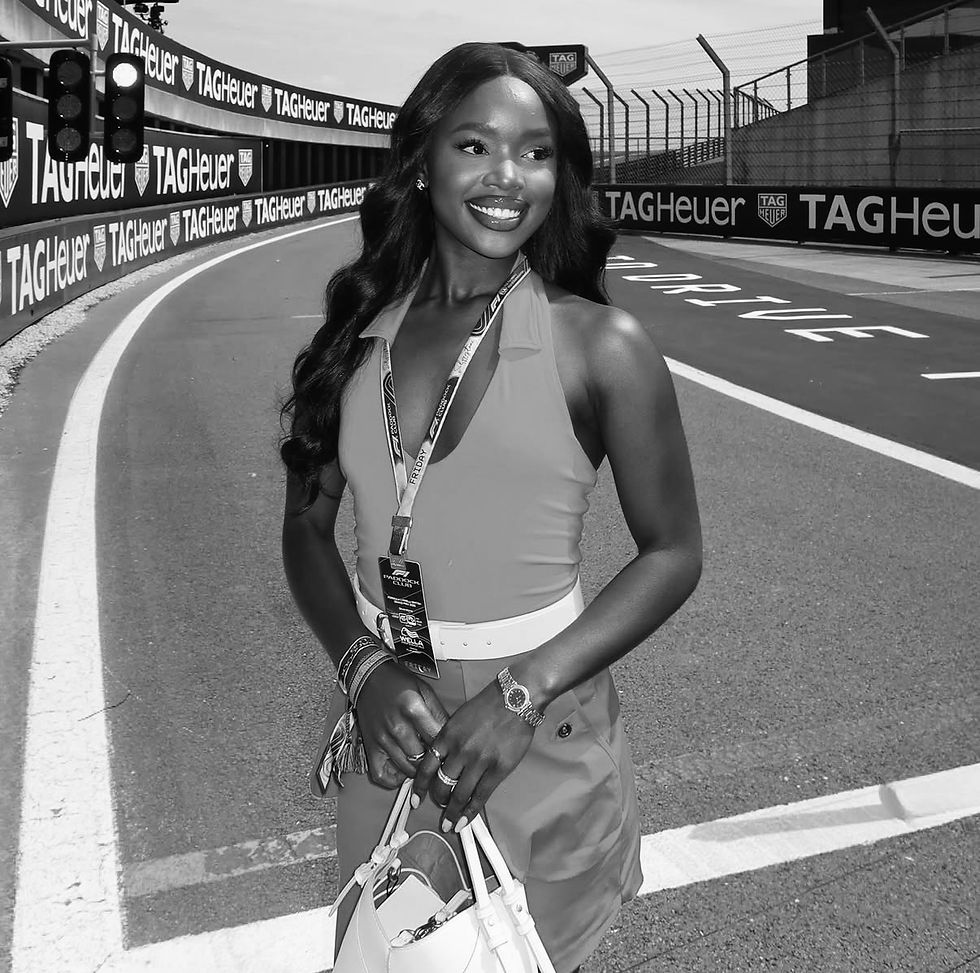
Noky Simbani represented this perfectly throughout the weekend. Working with M&S and Wella Hair across all three days of the British Grand Prix, her looks captured the essence of the modern Silverstone aesthetic: refined, confident and wearable.
Her styling reflected many of the same principles seen across the paddock in 2026—strong silhouettes, elevated basics, thoughtful layering and an understanding that fashion is ultimately about creating a feeling.
Nothing appeared forced or relied solely on a recognisable label.
Instead, the focus remained on the individual wearing the clothes.
And perhaps that is the most important lesson Silverstone 2026 offered.
The future of Formula 1 fashion is not about who can spend the most; it's about who can style the best.
The Future of Paddock Fashion: Why Silverstone Changed the Conversation

Perhaps the most interesting thing about the 2026 British Grand Prix was not that the paddock was exceptionally well dressed—it was why.
Fashion has always existed alongside Formula 1. From the impeccably tailored suits worn by team principals to the luxury partnerships that now shape much of the sport’s commercial identity, style has never been absent from the paddock. However, for a long time, fashion often felt secondary to status. The conversation centred around exclusivity: who was wearing the newest designer collection, whose handbag carried the highest price tag or which luxury watch had been spotted on a celebrity guest.
Style became shorthand for wealth, and wealth became shorthand for style.
Silverstone has now quietly challenged that assumption.
The shift was not that luxury disappeared. It was that luxury stopped being the only measure of a successful outfit.
Across the paddock, there was a noticeable change in how people approached dressing. Investment pieces and designer accessories remained present, but they no longer defined the conversation. Instead, attention moved towards outfits that demonstrated thought, personality and an understanding of the environment. Crisp tailoring was paired with relaxed denim. Everyday wardrobe staples were elevated through styling. A beautifully cut leather jacket carried just as much impact as a runway piece because it felt authentic to the setting.
For perhaps the first time, it felt as though the paddock was dressing with Formula 1 rather than simply dressing for attention around it.
Too often, fashion at sporting events becomes disconnected from the event itself. Clothing becomes the focus, while the occasion becomes little more than a backdrop for photographs. Silverstone offered something different. The strongest looks acknowledged the reality of the weekend: walking between garages, standing trackside, navigating unpredictable weather and immersing yourself in one of the world's most iconic sporting environments.
The outfits worked because they belonged there.
Fashion has always been at its most compelling when it reflects real life. The greatest designers do not create clothing in isolation; they create pieces that consider movement, identity and the way people experience the world. The Silverstone paddock reflected that same philosophy. Clothes were not simply being worn to impress—they were being worn to participate.
It also mirrors a wider transformation taking place across fashion. The era of obvious logos and conspicuous consumption is gradually being replaced by something more considered. Consumers are increasingly drawn towards versatility, longevity and individuality. They want wardrobes that exist beyond a single photograph. They want pieces that can be styled repeatedly and adapted to different moments.
The paddock appears to be embracing that same mentality.
Over the past decade, the sport has expanded into a global cultural force, welcoming new audiences who engage with every aspect of the experience—not just the racing. As Formula 1 continues to evolve, the culture surrounding it must evolve too. Fashion has an important role in that process.
It should inspire participation, not create distance.
For years, coverage surrounding Formula 1 fashion—particularly around drivers’ partners, influencers and celebrity guests—has often unintentionally suggested that great style requires extraordinary spending power. Outfits are frequently analysed through their individual costs, turning fashion into a financial calculation rather than a creative one.
There is nothing wrong with celebrating luxury craftsmanship. Designer fashion has an important place, and investment pieces can be genuinely special. But focusing only on cost overlooks the quality that makes an outfit memorable: styling.
A beautifully tailored blazer can have more impact than an expensive piece with poor proportions. A great pair of jeans can become the defining element of a look when styled correctly. A vintage jacket, an interesting shoe or a carefully chosen accessory can create more personality than a wardrobe built entirely around recognisable logos.
That was the message running throughout Silverstone 2026.
Sophie Milner demonstrated the power of restraint, proving that clean lines and precise proportions can be just as captivating as bold fashion choices. Kezia Cook embraced Formula 1’s heritage without allowing it to become costume, using motorsport references through attitude, silhouette and styling rather than obvious imitation. Coco Beautea captured the effortless confidence of modern paddock dressing, proving that the most successful outfits are often those that feel natural rather than manufactured.

Three different aesthetics, one shared philosophy.
None of these looks succeeded because of price alone.
They succeeded because they understood balance, proportion, colour and personality.
The significance of Marks & Spencer’s pit lane fashion show only reinforced this idea. Its presence at Silverstone represented a broader shift: the recognition that fashion within Formula 1 can be aspirational without being exclusive. It showed that style does not have to exist behind a barrier, and that the most inspiring outfits are often the ones that encourage people to reconsider their own wardrobes.
Rather than asking people what they cannot afford, it encouraged them to think differently about what they already own.
That is a much more exciting future for both fashion and Formula 1.
The modern paddock should be a space where individuality takes priority. Where vintage denim can stand alongside luxury accessories. Where a perfectly fitted blazer can attract as much attention as a couture gown. Where creativity matters more than cost.
Silverstone 2026 suggested that this future is already beginning.
As Formula 1 continues to establish itself as one of the defining cultural forces in modern sport, its relationship with fashion will only become stronger. The challenge will be ensuring that relationship remains creative rather than exclusive. The paddock has the opportunity to become one of the most interesting style environments in the world—not because everyone dresses the same, but because everyone brings their own interpretation of what Formula 1 fashion can represent.
Because the future of paddock style is not built on designer logos alone.
It is built on confidence, thoughtful styling, and clothing that feels lived in rather than simply displayed.
That is what Silverstone became in 2026: not a showroom for luxury labels, but a celebration of personal style. A place where motorsport heritage meets modern fashion, where practicality is no longer the enemy of elegance and where a perfectly cut pair of jeans can feel just as meaningful as a couture gown.
If Formula 1’s future is about opening its doors to new audiences, then its fashion should do the same.


Comments