BLINK AND YOU'LL MISS IT

Updated: Jul 27
The Engineering Behind a Two-Second Formula One Pit Stop

A Formula One pit stop lasts around two seconds…
That's less time than it takes to read this sentence.
Most of the time, a pit stop looks effortless. The car stops, four tyres disappear, four new ones appear, and the driver is back on track before you've had time to blink.
But behind those two seconds lies months of engineering, relentless practice and one of the most precisely choreographed operations in modern sport.
A fast pit stop isn't just about changing tyres. It's a masterclass in mechanical engineering, human performance and teamwork.
Precision Before The Pit Lane
Pit lane engineering begins well before we hear the words "Box, box".
Each pit crew member has their own individual responsibility. Around 20–22 people surround the car when it arrives, each performing a task that has been refined to eliminate every unnecessary movement. Three mechanics are assigned to each wheel: one removes the old tyre, another fits the new one, while a third operates the wheel gun. Front and rear jack operators lift and lower the car, while additional crew members monitor safety and control the driver's release.
It's high-pressure and fast-paced, but meticulously coordinated so that every movement has been carefully engineered.
Even the position of the car is critical. Drivers aim for the painted reference marks on the pit box, often practising their stopping position repeatedly throughout the weekend. Throughout pre-season testing, teams rehearse race operations including pit entry and pit lane speed limiter practice, as well as accurate positioning. Miss those marks by just a few centimetres in the race and the jack operators lose precious time repositioning the car.
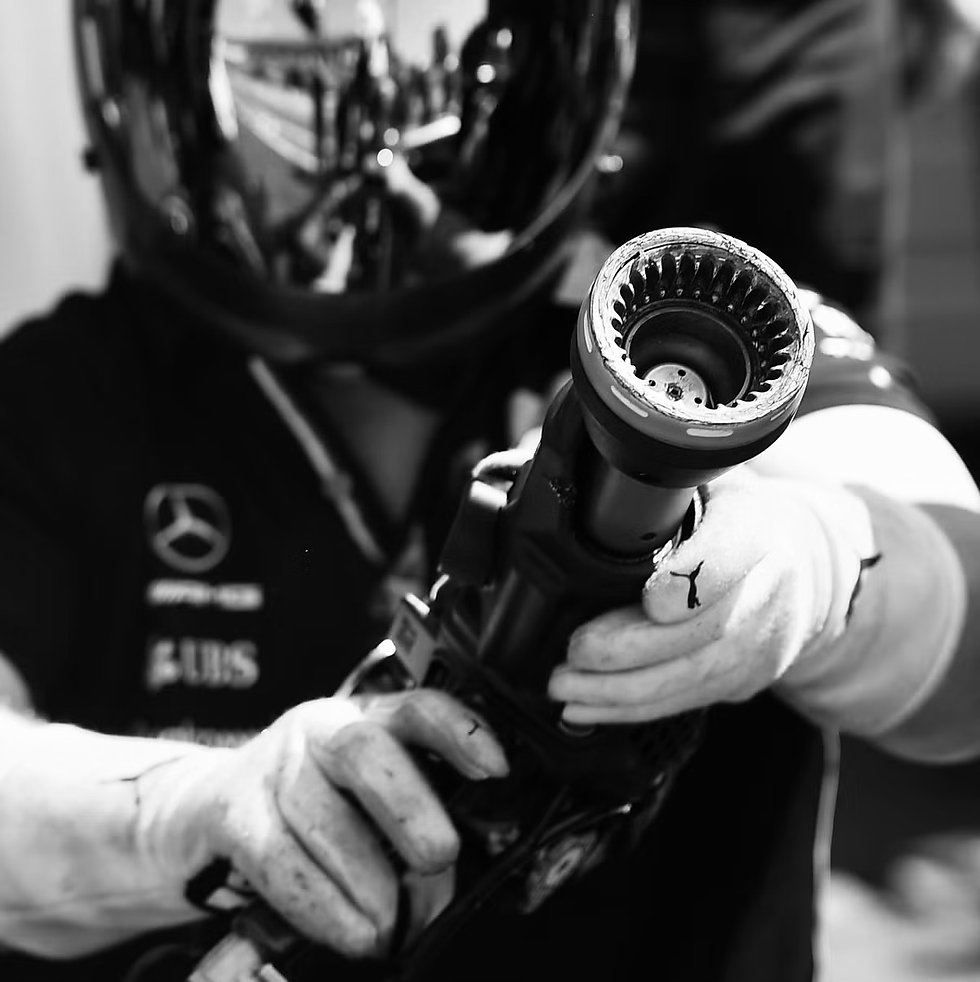
The Tool That Saves Tenths
The loud crack you hear during a pit stop comes from one of the most specialised tools in motorsport.
Formula One wheel guns produce extraordinary levels of torque (up to around 4,300 Nm), allowing a single central wheel nut to be removed and refitted in fractions of a second. Despite this immense power, they weigh only a little over three kilograms, making them light enough for mechanics to handle repeatedly with incredible precision.
Every millisecond matters. The wheel gun must engage perfectly with the wheel nut; if it slips or doesn't lock correctly, the entire stop is compromised.
In modern Formula One, races are no longer won by huge margins. Qualifying sessions are often decided by just a few hundredths of a second, and a pit stop that’s two-tenths slower can be enough to lose track position. We've seen this already throughout the season with Kimi Antonelli securing pole by under three tenths of a second in Suzuka qualifying; the top five in qualifying at the Red Bull Ring being covered by 0.362 seconds, and Gasly missing Q3 in multiple races by under 0.05 seconds.
Particularly on circuits where overtaking is difficult like Monaco, Hungary or Singapore, a tenth up in a pit window can be the difference between rejoining the track ahead of a rival or behind them. Losing positions in pit time means spending the rest of the race stuck in dirty air, unable to pass...turning a 0.1-second delay into a much larger loss over the course of multiple laps.
Because in 2026 the competitive field is often separated by mere tenths of a second, pit stops have become another engineering battleground. Teams invest heavily in bespoke jacks, refined procedures, performance analysis and training because the reward isn't simply a faster stop...it's championship points.
Synchronised To The Millisecond
What separates an average pit stop from a world-class one isn't strength—it's choreography.
Mechanics follow rehearsed patterns and aim to move almost instinctively to prevent confusion. If one crew member reacts even a fraction of a second late, it creates a chain reaction that delays everyone else.
Formula One teams rehearse pit stops constantly. Some teams complete dozens of practice stops during a race weekend, alongside extensive factory training between Grands Prix. Every stop is filmed, analysed and broken down frame by frame to identify where tenths (or even hundredths) can be saved.
The objective isn't perfection once...it's perfection every race.
The payoff of this synchronisation is seen on race day. At the 2026 Japanese Grand Prix, Ferrari completed a flawless pit stop of exactly 2.00 seconds for Lewis Hamilton, earning the DHL Fastest Pit Stop Award.

The Human Element
The limiting factors of most unsuccessful pit stops are often no longer due to machinery - it's due to the people.
Once the tools and equipment have been engineered for maximum performance, attention turns to the mechanics themselves.
Formula One teams study reaction times, fatigue, ergonomics and consistency just as closely as they analyse aerodynamic performance. Every movement is analysed to eliminate wasted time and reduce the chance of error. The placement of the wheel guns, the height of the jacks and the positioning of each mechanic are all carefully considered to minimise unnecessary movement, while mechanics train to perform under immense pressure, often with heart rates comparable to those of elite athletes.
Unlike specialist pit crews in some American racing series, Formula One mechanics aren't hired solely to change perform pit stops.. Throughout a race weekend they're assembling the car, repairing damage and supporting the engineering team before stepping into one of the most demanding, high-pressure jobs on the circuit for just a two-second window.

Formula One Vs. Formula Two
At first glance, Formula One and Formula Two pit stops look almost identical. Both involve changing four tyres before sending the driver back into the race.
But the reality is very different.
Formula One teams typically complete stops in around two seconds using larger pit crews, bespoke equipment and highly specialised wheel guns. Formula Two teams, however, usually require between four and seven seconds. This isn't because their mechanics are less capable, but because the championship deliberately limits resources.
An F2 team operates with roughly a dozen operational staff at the circuit, compared with more than 50 personnel trackside for many F1 teams. Mechanics often perform multiple roles across the weekend, and the series uses standardised electric wheel guns and jacks rather than bespoke systems developed by individual teams.
Formula Two is limited purposely for many reasons.
The championship generally operates under a much smaller budget than F1, with standardised equipment and smaller trackside teams to keep it financially accessible for teams and drivers. Additionally, F2 focuses on developing talent. The series is designed to prepare drivers, engineers and mechanics for Formula One. Unlike Formula One, F2 is a spec series, meaning that each team used the same chassis, engine and equipment. standardising pit stop tools therefore prevents wealthier teams from gaining an advantage through technology.
In F2, success comes from extracting performance, rather than designing a faster car.
The difference in pit times between F1 & 2 reflects the philosophy of each championship. Development versus peak performance.
The Bigger Picture
The next time you watch a Formula One race, don't blink when the cars dive into the pits.
Those two seconds that seem like nothing to viewers actually represent thousands of hours of engineering, analysis and practice compressed into one perfectly synchronised performance.
Formula One is often described as a team sport disguised as an individual one. While the drivers are the faces of the championship, a pit stop is one of the rare moments when the spotlight shifts to the people behind the scenes. Appreciating the engineering and precision involved reveals just how much success depends on the collective effort of the entire team.
And when everything goes right, you barely notice a pit stop even happened.


Comments